This is held at the Land Registry in favour of Al Rayan, with a note on it indicating the existence of a leasehold interest on the property too.
Al Rayan Islamic Mortgage Review: The Definitive Guide

In this Article

Mohsin Patel
Co-founder
12 min read
Last updated on:
Editor's note 2025: Please note that Al Rayan have stopped offering a home finance product. You may want to instead check out our review of Gatehouse Bank instead. To find the latest information, check out our Islamic mortgages page.
We have written extensively on Islamic mortgages at IFG (see here and here for example and definitely also check out our cool Islamic mortgage comparison tool), but we have previously kept the discussion generic. In this article, for the first time ever, we exhaustively go through Al Rayan’s Home Purchase Plan ( the “HPP”) in particular.
We are confident that nothing as detailed as this has been done for the Al Rayan (formerly Islamic Bank of Britain) HPP. In this article we examine the legal, Islamic, commercial and practical aspects of the HPP informed by:
- a close read of Al Rayan’s legal documentation;
- a wide-ranging survey of Al Rayan customers; and
- hundreds of discussions we’ve had with professionals, Al Rayan staff and scholars over the last few years. In short, this has been a time-intensive exercise for us, but inshAllah it is the best resource out there for Muslims wanting to properly understand the Al Rayan mortgage both Islamically and commercially.
Summary
Yes, we’re starting with a summary (there’s nothing worse than trawling through 4,000 words to find a one-paragraph summary tucked away!).
Our conclusion is that, given the current UK context, the HPP is the best Islamic mortgage option out there for those who qualify under the Al Rayan eligibility criteria. However we do have some bones to pick on both the commercial and Islamic side with the HPP as it currently is. We believe the HPP could be better from both a commercial and Islamic perspective if a few tweaks were made to it. We hope this article will help pave the way to making these changes.
From our personal perspectives, Ibrahim has an Al Rayan mortgage, while Mohsin has opted for Heylo Housing (but plans to shift to Al Rayan in the coming years). You should definitely also check our our Islamic mortgage comparison page. It is the only one of its kind in the UK.
Islamic & Legal Analysis
What is the structure being used here?
The Al Rayan Islamic mortgage is structured as a Home Purchase Plan. This is a regulatory structure that was specifically created through legislation to assist the Islamic finance industry in being able to provide an Islamic alternative to mainstream mortgages.
For a product to be a legal HPP structure, the bank must hold the buyer’s beneficial interest on trust to be delivered over to the buyer once he has paid off the amount necessary to buy the full interest in the property. At this point the buyer will be transferred over the legal title and will hold complete legal and beneficial interest in the property.
“Hang on, what’s all this beneficial v legal gobbledygook?” you might be saying.
Simply put, a legal owner of a property is the “formal” owner of the property, i.e. the one whose name is on the freehold title at the Land Registry. A beneficial owner is someone who has the right to enjoy or benefit from the property, and this can include the right to any income from the property or to reside in the property.
To complicate matters further, an interest in a house can be a freehold or a leasehold. A leasehold interest is different from a freehold in that it is necessarily time-restricted. A leasehold could be for a few days, or many hundreds of years, but eventually it will expire. When it does expire, the freehold owner will be able to step in and take possession of the property.
The Al Rayan HPP uses a combination of freehold and leasehold to deliver a diminishing musharakah/ijarah model (N.B. that musharakah means “partnership” and “ijarah” means rent). This Islamic finance model goes thus: the buyer of the property slowly buys more and more of the house over time, and his rental payment on the amount he does not own slowly decreases at the same proportion. Eventually he owns the entire house and is no longer paying any rent.
This is a little diagram of how the whole thing works:
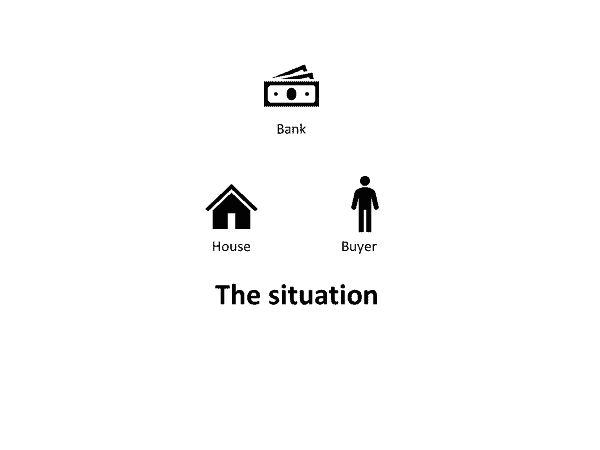
So the situation is that the Buyer wants to buy the House, but he doesn’t have enough money to buy outright. But he does have enough for a 25% deposit. So he approaches Al Rayan bank – and this is what happens:
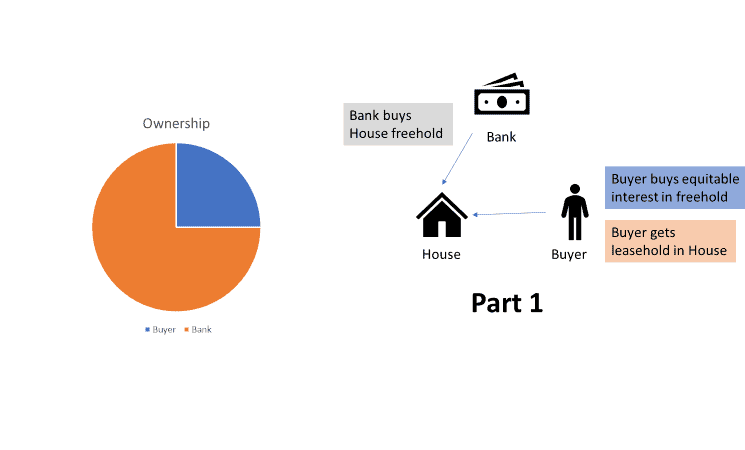
Al Rayan buys the freehold title in the house at the closing of the transaction, and it is its name that appears on the title. But the buyer gets an equitable interest in the freehold by way of the contract (the DCA – more on that below) and also gets a leasehold for 99 years alongside Al Rayan. This leasehold can only be sold or ended by the consent of Al Rayan, but it does put the buyer on a more secure and long-term footing than a shorter lease would.
Time passes, the Buyer continues paying rent and buying further equity in the House until eventually he owns 100%.
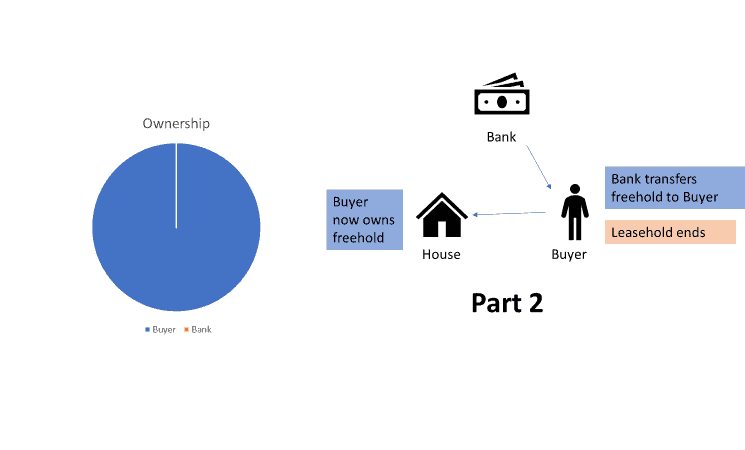
At this point the Bank transfers over the freehold interest in the property to the Buyer, the leasehold ends, and all charges in favour of the Bank are removed from the charges register.
HMRC is thankfully agreeable to only charging Stamp Duty Land Tax (“SDLT”) once, and so SDLT is only payable upon the initial purchase of the house, and not on the final transfer of the freehold by the bank.
Incidentally, this is one area where Al Rayan has an advantage over Heylo.
Review of the legal documentation
There are 6 important legal documents that come together to form the legal fabric of the Al Rayan HPP. We consider each of these in turn.
- The Freehold Title (hover for a definition)
- The Leasehold Title (hover for a definition).
- The Diminishing Co-Ownership Agreement (the “DCA”)
- Lease Agreement
- Service Agency Agreement
- Legal Charge Agreement
Glossary of Legal Agreements
Freehold Title
Leasehold Title
This is jointly held by Al Rayan bank and the Buyer and notes the existence of a charge in favour of Al Rayan in the Charges Register associated with this leasehold title.
DCA
This is the crucial document that governs the duties and obligations of each party in the initial purchase of the property and the gradual buy-back of the property. It is separate from the lease agreement. It only covers the acquisition cost of the bank, i.e. the initial amount they pay to the seller alongside your deposit.
Here’s a few quibbles we had with this document:
- (5.2) Delay payment – There is a delay payment due to Al Rayan in case you are late in making payments, which Al Rayan subsequently give away, but only after deducting any loss they have suffered as a result. The underlying issue here is that receiving an additional payment above and beyond the due amount as a result of a time delay is considered riba in Islamic law. That’s why Al Rayan gives it away. We are happy Al Rayan to charge this amount, as they need to in order to deter late payments. Our issue is that this will be extremely hard to quantify and practically, the only easy way to quantify it is using interest rates as a proxy. So we’d be interested to hear how Al Rayan practically handles any delay payment money and whether it actually deducts any amount before giving it away to charity.
- (5.3) Tariff List – Firstly, as part of the Tariff List, the buyer has to pay the ground rent. This is typically the responsibility of the freehold title holder – Al Rayan in this case. We can understand why Al Rayan do it commercially – as ground rent can vary hugely and be relatively expensive – which would eat into their margin, but its one of those things that could be reviewed by Al Rayan and paid pro rata to their share. Secondly, there is a £25 administration fee for early repayments. Al Rayan have to allow early repayments as part of the teachings of Islamic law and the minimum early repayment sum is £4000. My concern is that over the course of a two-decade mortgage, an individual may well make over 20 early repayments. This would add up to £500, or 0.5% of a £500,000 financing, for example. 0.5% (or more) actually moves the needle a bit, and I would like to better understand whether £25 is a fair administration fee in this respect.
- 6.1(a) – if the house is destroyed through an insured risk, and the cost of rebuild will be such that the maximum finance-to-value that the bank initially agreed to, is exceeded, then the bank would rather sell the house than rebuild. I get why they would do that (don’t want to overexpose themselves to that individual more than they initially agreed based upon their due diligence) but it does seem rather like kicking a man when he’s down. Though – on the bright side – in the lease you don’t have to pay rent if your home is destroyed.
- (7.4) Reselling your house – bizarrely, you need Al Rayan’s permission to sell directly (unless to family), but you can sell without their permission through an estate agent (though ultimately they will need to be paid off in this case anyway).
- (9.2)(a) Exclusion of liability – the exclusion of Al Rayan liability includes any damage or defect in or to the property (whether such risk is insured or not). The issue here is that Islamic mortgages are supposed to be distinct from normal mortgages due to the different risk profiles (as the economics are largely symmetrical), so the more Al Rayan excludes its liability, the more like a conventional mortgage it becomes. In our view Al Rayan should not be excluding risk that is not insured, because that is then basically leaving them without any exposure to risk that not otherwise covered by insurance or excluded through a contract like the DCA. But more on this insurance point below. To be fair, what is going in their favour in this section is that they don’t force the buyer to pay them their remaining finance amount in the case of a house being destroyed – but they make sure the buyer has to take out an insurance policy sufficient to cover them anyway.
- Schedule 2 (7) – The buyer is required to insure the property entirely at his own expense. We don’t like this – more on this below.
Lease Agreement
This is the agreement through which the bank charges the equivalent of “interest” under a conventional mortgage structure. In other words, this is the agreement that governs the varying rate that the bank charges each month, depending on LIBOR.
Here’s a few quibbles or notes we had on this document:
- (6.1)(b) – you don’t have to pay rent if your home is destroyed. This is a good thing and a genuine difference between Al Rayan and a conventional lender who would continue charging interest.
- (12) – Al Rayan have excluded liability for any damage caused by them (or someone they’ve appointed) to the property. Circumstances in which the bank would have to get hands-on and do something substantive to the property are unlikely, but they can arise (for example, you tell them of a major structural flaw, and don’t sort it out within a defined period of time set by them and they then have to step in by sending their contractors over). In this case, I would want confirmation that the bank will appoint insured contractors and that I will be able to pursue the bank-appointed contractors for indemnification directly. Because otherwise, if the contractors are hired by the bank, and the bank isn’t interested in pursuing them due to any faults in their work, you as the home owner are not in a great position. But we do caveat all this with the emphatic this is very rare.
Service Agency Agreement
This is the agreement through which the bank requires you to maintain and insure the property. This is to make sure that their secured asset (which they can sell in case of default) is kept up to a standard such that it maintains its value. Additionally, it requires you to insure the property so that in the case of an unforeseen disaster, you and the bank are covered for that loss.
The main quibble we had with this document was:
- (2.2) – under the service agreement the buyer can get paid £1 on written demand and in all cases prior to the signing of the agreement. In other words, no one will ever demand this, and by the time they sign, it’ll be too late to demand it. But I might well demand it next time I take out an Al Rayan mortgage!
Legal Charge Agreement
This is the agreement through which the buyer charges the property against the sums owed to the bank under both the DCA and the lease agreement.
Which scholars approve and disapprove of the Al Rayan HPP?
Are there any issues?
Insurance
An Islamic mortgage necessarily needs to be substantively different from a conventional mortgage. It can’t just be cosmetic changes. We are told that the HPP is substantively different from a conventional mortgage in a number of ways, primary among them the fact that the bank takes on a different set of risks to that taken on by a conventional provider. Let’s take a closer look at some of the key risks at play here.
| Scholar | Opinion |
|---|---|
| Shaykh Haitham Al-Haddad | The Al Rayan HPP is not Islamic; it is too much like a debt instrument (i.e. the buyer is locked into purchasing the entire finance amount back from Al Rayan from day one). |
| Shaykh Akram Nadwi | Get a conventional mortgage if necessary, as Islamic finance is just like conventional finance dressed up in a religious garb. |
| Shaykh Suhaib Hasan | (at least in particular cases): get a conventional mortgage if necessary. |
| Shaykh Abu Eesa | The Al Rayan HPP is fine |
| Sheikh Dr Abdul Sattar Abu Ghuddah | The Al Rayan HPP is fine |
| Sheikh Nizam Muhammed Saleh Yaqoobi | The Al Rayan HPP is fine |
| Mufti Abdul Qadir Barkatulla | The Al Rayan HPP is fine |
| Sheikh Muhammad Taqi Usmani | The Al Rayan HPP is fine (though we note he is retired from the Al Rayan Shariah Supervisory Committee) |
- Al Rayan should purchase the insurance for each of its properties. It should purchase a global insurance policy and, if it really wants to, pass on the cost through a slight increase in its global profit margin. But the fact that insurance is used to hedge so much of the bank’s risk, and is also bought by the buyer seems unfair and sends the wrong message to the customer.
| No. | Risk | IFG Commentary | Risk borne by |
|---|---|---|---|
| 1 | House damaged or made defective by an insured risk | This liability has been excluded pursuant to clause 9.2(a) of the DCA. | Insurer |
| 2 | House damaged or made defective by an uninsured risk | This liability has been excluded pursuant to clause 9.2(a) of the DCA | Buyer |
| 3 | Cessation of rent payments if a house gets destroyed/uninhabitable | This liability has not been excluded. Al Rayan is on the hook for this | Al Rayan |
| 4 | Insurance money not being enough to cover damages and/or exceed the maximum finance-to-value ratio | The bank has got the right to not rebuild the property but to simply sell the property further to clause 6.1 of the DCA | Buyer |
| 5 | The buyer doesn't insure the property | The bank has got an indemnity from the buyer in clause 7 of the Service Agreement which means the buyer pays | Buyer |
| 6 | Bank has to get work done to the property and damage is caused by its employees or agents to the property in the process | The bank has excluded this liability in clause 12 of the Lease Agreement | Buyer |
| 7 | The value of the property decreasing | Al Rayan simply won’t sell at below market value – or to the extent you would like to, then you need to pay off the remaining amounts due with Al Rayan receiving the acquisition payment they made initially | Buyer |
Mohsin Patel
Co-founder
Mohsin is the co-founder of IslamicFinanceGuru, an Oxford graduate and a Forbes 30 under 30 alumnus. He's a former corporate lawyer at one of the world's largest US firms. Whilst running IFG, Mohsin is also actively interested and invested in the web3/crypto space. Publication: Halal Investing for Beginners: How to Start, Grow and Scale Your Halal Investment Portfolio (Wiley) Mohsin is the co-founder of IslamicFinanceGuru, an Oxford graduate and a Forbes 30 under 30 alumnus. He's a former corporate lawyer at one of the world's largest US firms. Whilst running IFG, Mohsin is also actively interested and invested in…
Comments (0)
Related Articles
View all

Islamic Mortgage Remortgage Guide: What to Do When Your Fixed Term Ends

Ibrahim Khan
02 December 2025 8 min read

Is StrideUp The Best Islamic Mortgage Provider In The UK? (2026 Review)
Ibrahim Khan
05 September 2025 11 min read
Leave a Reply